

At the 10th anniversary of the Paris Agreement, debates promoted by the Regional Climate Foundations at COP30 in Belém focused on initiatives that can improve the implementation of countries’ climate commitments. One of them, held this Wednesday, 12, discussed the COP30 Brazilian presidency suggestions of reforming UN bodies to achieve more results from the climate conferences.
“We have reasons to think about this”, introduced the special advisor to the Presidency of the Republic of Brazil on Finance and Climate, Tatiana Berringer. She mentioned the decreasing credibility of the UN system and the multilateralism itself, but also that climate issues need to be at the center of all the UN discussions, not only during COPs discussions. “And we must ask ourselves, is the UNFCCC delivering the results the world needs”?, added.
This last point was the main guide for reflections expressed by the participants — among them, the UN Special Rapporteur on Climate Change and Humans Rights at the United Nations Humans Rights, Elisa Morgera, and Leonardo Brant, judge at the International Court of Justice, that recently stated that parties have legal obligations to take action on climate change, including mitigation and adaptation measures.
“We need to think about what institutional reforms can make the UN system more coherent, without destroying or rediscussing the Paris Agreement, but instead, focusing on having an arm that delivers implementation towards the 1.5ºC goal”, provoked the executive director at LACLIMA, Caroline Rocha.
Despite the criticism, Kaveh Guilanpour, the vice president for international strategies at the Center for Climate and Energy Solutions reminded the audience the successes of the Paris Agreement: the instrument was capable of putting the planet in a trajectory of temperature containment — still at a high level, but not the worst predicted.
Recognizing these achievements, some suggestions emerged. Giovana Kuele, program manager for International Cooperation and COP30 Strategy at Igarapé Institute pushed for building synergies among the UN frameworks that already exist, such as the climate change and the biodiversity one: “Climate and forests are not dissociated, and we must to address the current crisis by looking to both”.
Elisa Morgera urged for the UNFCCC secretariat to prepare briefings to all the parties based on science consensus on climate, biodiversity, oceans, land degradation. “Not all the negotiators have the same level of knowledge, and our decisions must be taken based on the best science we have”. She also asked for a more open discussion, with any individual being allowed to provide suggestions to the plenary — as it happens in the biodiversity COP. Finally, she asked for a better governance of the UNFCCC to prevent the conflict of interests inside the climate conference. “Every year we see fossil fuel lobbying increasing inside COPs”, regretted.
Finally, many of the participants agreed that a climate council for the UN — as it was proposed by the Brazilian presidency — would be a great innovation, and a way to tackle implementation measures to make real progress.
Implementation observatories

While the UN system reform is under discussion, some initiatives started to bring to the debate new data and analysis to measure the implementation of Paris Agreement commitments.
The Global South Climate Ambition Observatory, launched in a debate this Tuesday, 11, aims to monitor and compare climate ambition among eight countries from the Global South, as well as the state of the implementation of its commitments. “Our objective is to strengthen data transparency and develop a common measuring rule for progress”, explained one of the creators of the platform, Maria Beatriz Mello, researcher at the Brics Policy Center.
As an initiative originated in a laboratory that studies the Brics countries, the team first focused on this group of countries and developed analyses for Brazil, China, India, Indonesia and South Africa — five of the 11 current effective members of the Brics group. They are now collecting data also from Egypt, Ethiopia, and the United Arab Emirates (UAE).
“But we realised that it would be important to expand this analysis for countries from the Global South, that have political and economic relevance and abundance of natural resources”, mentioned Maureen Santos, coordinator at the Brics Policy Center. So, the researchers included Colombia, Mexico and Democratic Republic of Congo in the first version of the observatory. “We expect to keep growing the number of countries, and also develop new categories of analysis”, she added.
The Global South Climate Ambition Observatory scrutinizes not only the country’s NDCs, but also looks for other policies that are not directly connected with climate, but can impact it. “We are offering a more comprehensive vision of ambition, including environmental policies in general,” concluded Santos.
Disclosing performance gaps
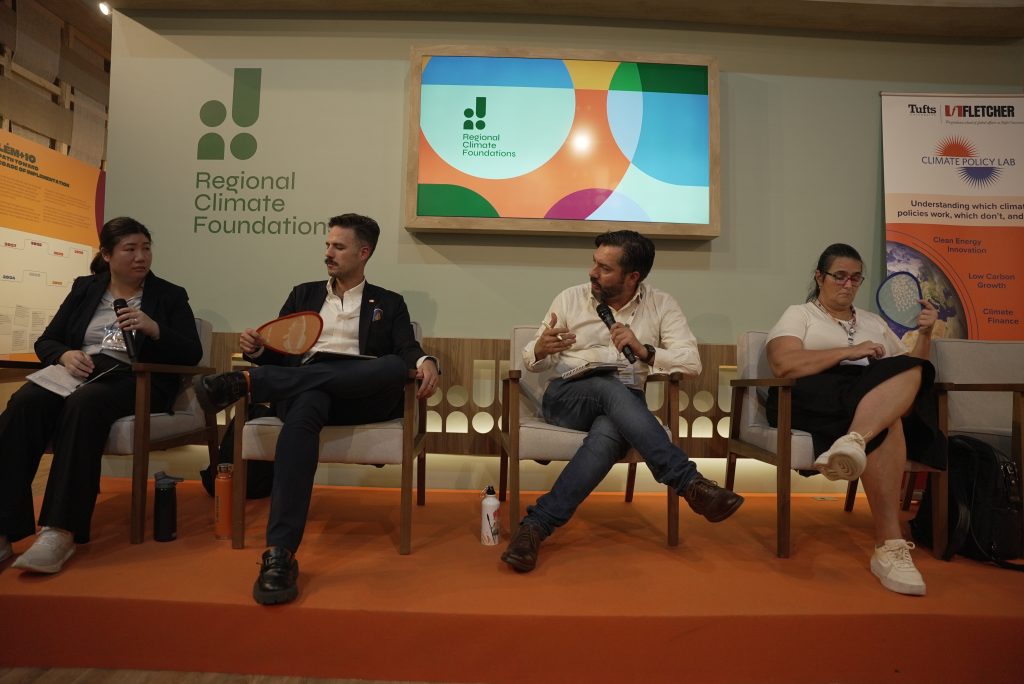
“There is no more important issue than the implementation gaps”, introduced the Director of Climate Policy from the Mexican Climate Initiative, Jorge Villarreal, mediator of the panel “Advances in the implementation of climate policy”. At this event, researchers from Tufts University presented their analyses of the progress made by Mexico, South Africa and Brazil on their climate commitments — a part of a bigger study that included India, China and Indonesia.
They found that even in cases that the policies are addressing the climate issue, there are other measures needed for the implementation to be achieved, such as a clear budget for executing the plans, as well addressing inconsistencies between rhetoric and practice. This is the case of Brazil, which is publicly advocating the world moving away from fossil fuels, but recently announced the opening of a new frontier for oil exploration in the Amazon River mouth region.
Among all the participants, the certainty of the necessity of data transparency emerged. “Without data we can’t certify anything as green, we can’t make carbon accountability, we can’t monitor how we are going on implementation”, concluded the Brazilian researcher Rosana Santos.