
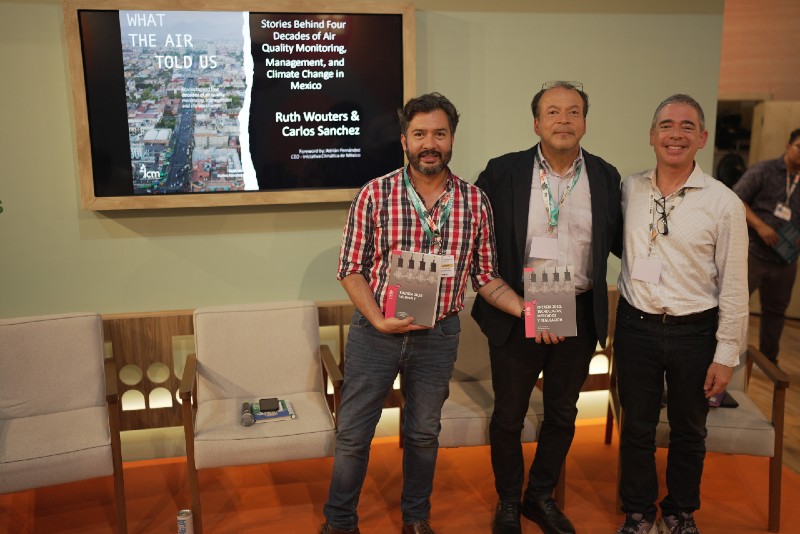
Two books released this Monday, 17, at the Regional Climate Foundations pavilion show the evolution and challenges for energy transition and quality air improvement — and the relation of both issues with climate change.
David Enríquez, the organiser of ‘Energy 2050, technologies, market, and regulation. A Latin American perspective on the path to net-zero’ presented the two volumes of the collective work, which gathered 60 different authors from Latin America and Spain.
“Our effort was putting together in a picture different approaches to answer one very simple question: how can you see your own sector or area in 2050, aiming to achieve the net-zero objective”, explained Enriquez.
He also highlighted that the books are not designed as an academic source of information, but for a wide public interested in the subject.
“It is interesting to note that Latin America has a cleaner energy matrix compared with other regions”, observed one of the authors of the book, Luisa Sierra. According to her, 60% of the energy in the continent is based on sustainable sources. “Although, we need to increase ambition to achieve net-zero in 2050”.

Despite the diversity among the authors of the book, with different backgrounds, perspectives, and areas of expertise, Enríquez noted that two points were common to almost all the analyses: scale and speed.
“We see many things happening in our countries, but not on the scale or speed we need”, noted the executive director of the Mexican Climate Intiative, Adrián Fernández, who also participated in the debate. “With the new NDCs 3.0 goals, countries need to realize that they can’t keep moving in this inertial, gradual, slow way to bring a real energy transition”, concluded.
Forty years of air quality monitoring
The second book presented in the session was ‘What the air told us: Stories behind four decades of air quality monitoring, policy, and climate change in Mexico’, in which the chapters were written by researchers that have studied and monitored Mexican air quality for 35 or 40 years.
“The subject of air pollution is not new, but is not solved”, noted Adrián Fernández, from ICM, who wrote the presentation of the book.
He exemplified this, mentioning that currently the air quality in Mexico is, on average, five times better than in the 80s. But there is still a high concentration of pollutants and particles that can threaten human health.
“What happened is that the international standards for air contamination are becoming more restrictive than before. So we are moving forward, but the targets are moving faster than the solutions”, concluded.