
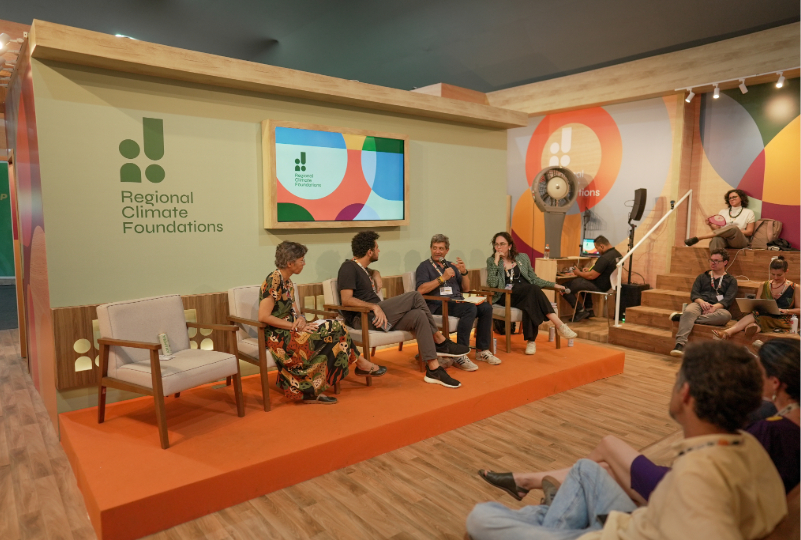
The idea of the Amazon as a vast and uninhabited territory that was hegemonic among scientists until the 20th century — and, among other consequences, fueled the Brazilian dictatorship policies in the 70’s, stimulating deforestation — is being challenged by scientific findings in recent years.
Studying the relations between indigenous people and nature, the Brazilian archeologist Eduardo Goés Neves discovered that the traditional communities in the Amazon interfered in the forest — but unlike what happens currently, they improved diversity. “The Amazon we know today was shaped over thousands of years by indigenous peoples. They are producers of landscape and, in some cases, are even understood as producers of nature.
His studies rely not only on ancient artifacts, but also on chemical analysis to find in the soil certain characteristics that allow him to interpret the results as consequences of this deliberate interference: “Around 2% or 3% of the Amazon soils were built by indigenous people. They are what we call ‘terra preta’, very fertile”, explains, breaking the old narrative on the supposed poor composition of soils in the region, what would be the reason for absence of human occupation.
“In Rondonia, there is evidence of regular human presence since nine thousand years, in a continuous form”, adds, highlighting that currently it is safe to affirm that between 8 and 10 million of indigenous lived in the Amazon in ancient times. They had constructed a complex of villages and cities connected through roads that can be seen from the sky through special equipment that goes beyond the forest coverage to map the traces of this ancient network.
This knowledge needs to be considered in the moment of thinking about the current Amazonian occupation. “We need to consider these local arrangements to planify our cities in the Amazon”, argues Ana Claudia Cardoso, professor at the Pará’s federal university (UFPA).
Forest-cities as a model for adaptation
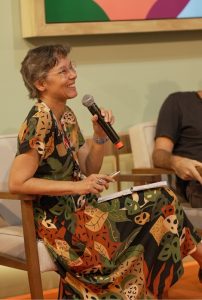
Cardoso reminds that the evidences reveals a big “forest-city” that had Belém — the Amazonian capital that is receiving COP30 this year — as its central point. “It was dense, but on an Amazonian scale. There were spaces for people, and for nature”, explains.
The currently urban spaces in the region forgot this, grounding small rivers, constructing under fertile lands. But, recovering ancient technologies and applying them in the present can help cities in adaptation to avoid the worst climate change impacts. “We need to reimagine our territories in a way that doesn’t lead us to collapse. This must be done using communitary practices that rely on this ancient knowledge”, concludes.
This is not the only possible outcome of the research on ancient Amazon occupation. Through the studies that reveal the complex of cities in the region — its roads, villages, cemeteries, and trash places — Eduardo Goés Neves research group aims to push for the official recongnition of this archeological heritage, forcing its protection.
“It is a path to reach protection of areas that are threatened by the current occupation of farms, roads, and economic activities”, explains. “Whe want to block its destruction”, adds.
Rescue of traditional practices lead to finance
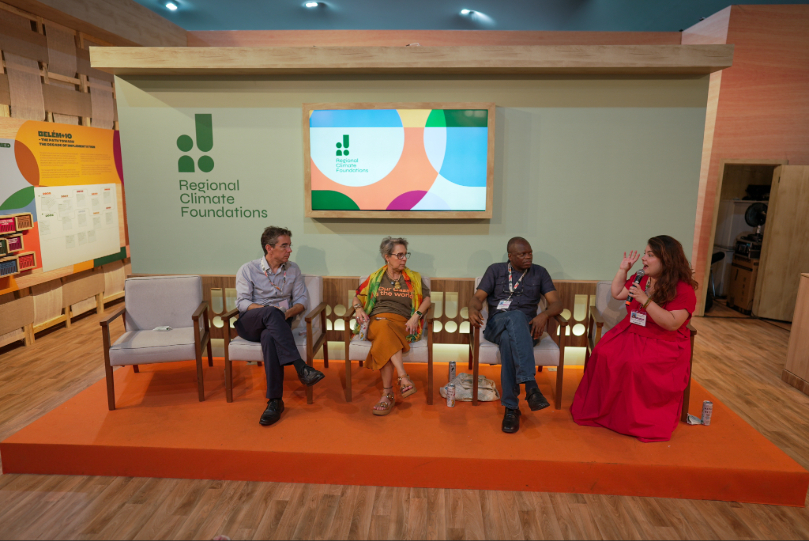
The traditional practices of local and indigenous people can also unlock finance flows that are difficult to access, panelists said this Wednesday, 19, at the Regional Climate Foundations pavilion. “Sometimes, scholars, scientists, experts or activists went to a community to offer solutions that were designed without consultation, and without considering the local dynamics and knowledge that are very valuable”, criticize Alphonse Maindo, from Tropembos, an organisation from Democratic Republic of Congo that led local restoration of degraded lands, providing economic opportunities for the communities.
To understand the communities demand, help them to navigate into a climate project, and also engage with the donors to sensitize them to local needs is the purpose of the Brazilian Fundo Casa Socioambiental. “The first thing to understand it that people that take care of the forests around the world many times need to improve their livelihoods”, explains its Global Philanthropy Strategies director, Maria Amália Souza.
In this sense, women and youth are the best pillars to develop projects on forest restoration, they highlight. “In many communities, man goes to the cities to get a job, exactly because the natural resources are not there anymore”, explains Maindo. “But after the projects, we see biodiversity reborning, the man camebacking and a whole village transformation”, celebrates, justifying that projects led by woman have preference to his organisation.
Closing the day at the pavilion, a meeting gathered leaders from Latin American communities reinforced the need of listening ancient knowledge. “The only way to move forward to a transformation in the world is putting people at the centre”, states the executive coordinator of Casa Fluminense, Larissa Amorim.
Her panel aimed to be a space for connections and dialogues between innovative practices of social mobilization for those who are at the forefront of territorial agendas for community resilience, inclusive adaptation, mitigation, and climate justice. “Traditional knowledge is a technology that leads to solutions”, concludes.