
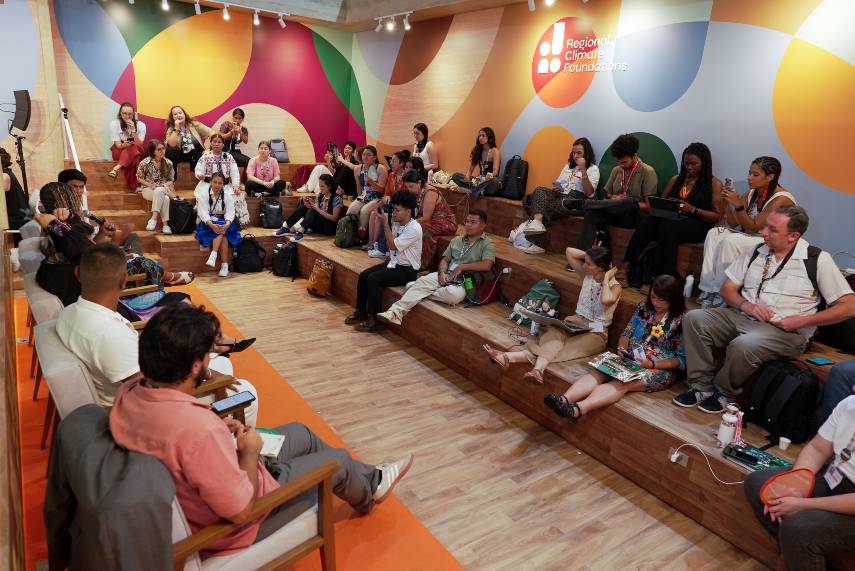
Adaptation was one of the main outcomes from COP30 — with the parties agreeing on tripling finance for this purpose, and on adopting voluntary indicators to measure progress on the adaptation goals. During all the climate conferences at Belém, panelists present in the Regional Climate Foundations pavilion also demonstrated that there is extensive knowledge available for better resilience practices.
With adaptation as one of the 10 subject priorities on space, many of the events touched on the theme, bringing different perspectives on the challenges for its implementation.
The last one took place on Thursday, 20, when leaders from communities in Bolívia, México and Brazil stated a clear message: no matter what the point is to discuss on adaptation, local voices might be heard. Not only because those communities represent some of the most affected people, but especially because they are already developing solutions. “It is a two-way road”, highlighted the climate policy advisor at PalmaresLab, Alex Soares, from Brazil.
Speaking on behalf of his community in the Caratateua island, in the periphery of Belém — the city that hosted COP30, in the heart of the Amazon — Soares demanded not only more incidence space for the impacted communities. He also asked for elements that could make the debate more accessible to the people in the real world.
“The concept of adaptation adopted at climate conferences refers to ‘the adjustment of human and natural systems’”, explains. “It does not bring a human perspective. It seems to refer to a large machine in which we are seen as pieces”, completed.
Negotiations are conducted entirely in English, but other languages need to be included in the rooms to democratise the debate, he asked. “There is no point in empowering communities if they arrive here and encounter this barrier”, added the moderator of the debate, Daniel Porcel, from Talanoa Institute, which is one of the 45 other organisations, from 13 different countries, on the Adaptation Task Force.
“Those voices must be heard. They have many contributions to the debate”, argued in another round table Leonildes Nazar, from the Institute of Climate and Society (iCS) — one of the eight regional climate foundations.
Territories are the link from global to local
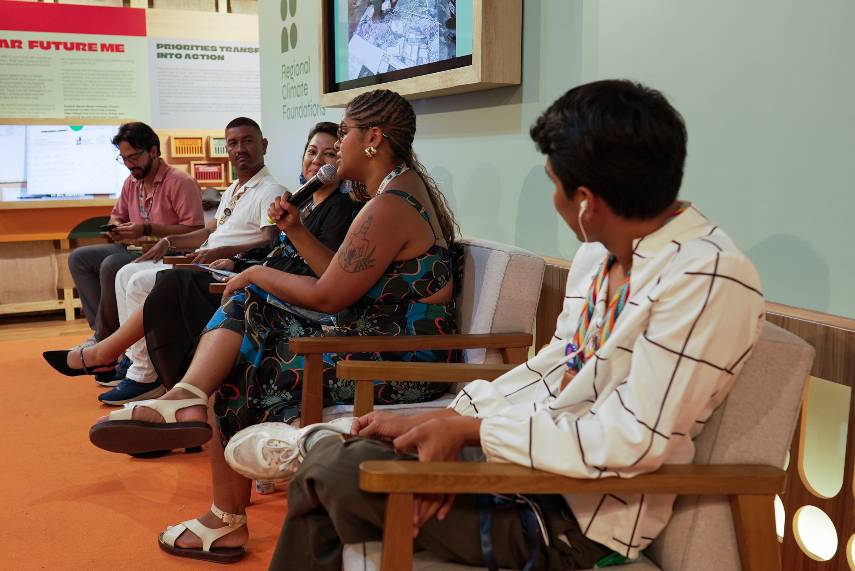
If in the meeting rooms and the plenary, the debate is made with a language that is inaccessible to all, the examples that came from the communities are didactics. “In the negotiating room, adaptation is a stalled issue, as countries are unable to reach an agreement. But adaptation is alive and well in Latin America and the Caribbean”, Porcel compared.
Many examples came through across the debates. In Bolivia, for example, where the Andes Mountains meet the Amazon Forest, Lorena Terrazas is helping a community to implement adaptation measures to climate change. One example: with the rising temperatures, people decided to change the time range for kids going to school. “They start the classes earlier, so they can return home before the sun is too hot”, explained.
Conversations with women from the villages in the region, who are usually responsible for providing food for the families, led to the rescue of the traditional rice seeds, lost due to the commercial variations. “The traditional seed is resistant to water”, explained, mentioning the increasing risks of floods.
On the Acari ‘favela’, in Rio de Janeiro, Brazil, the action started with residents working on data collection about the communities vulnerabilities. The citizen-guided dataset is published and can guide decision-makers. “Where there is no data, it is impossible to draw effective public policies”, justified one of the coordinators of the study, Mari Galdino. “We decided to provide this information so that this group of people can be prioritised when the budget is allocated”, added, highlighting that there are 16 million people living in ‘favelas’ and suburbs in Brazil: “They live in extreme vulnerability”, concluded.
Working on a rural community in Bahia, a northeast Brazilian state, professor Lourivânia Soares also organised a group of women to develop a community map of risk. Providing evidence of the risks faced by residents of this traditionally dry region, she regretted that the ancient knowledge is often ignored by climate experts. “We needed to use the language of science to validate what communities have known for a long time”, explained. Soares reproduced a testimony of a leader of this community, a griot master — a woman that communicated stories and history orally, as the African tradition — that, a decade ago, said the community was no longer in the semi-arid region, but in the arid region. “Now the study has come out, and the desertification was found”, explained. “But, in that moment, her social voice was not heard; she had no validated knowledge”, regretted.
Local Adaptation Plans as a solution for implementation
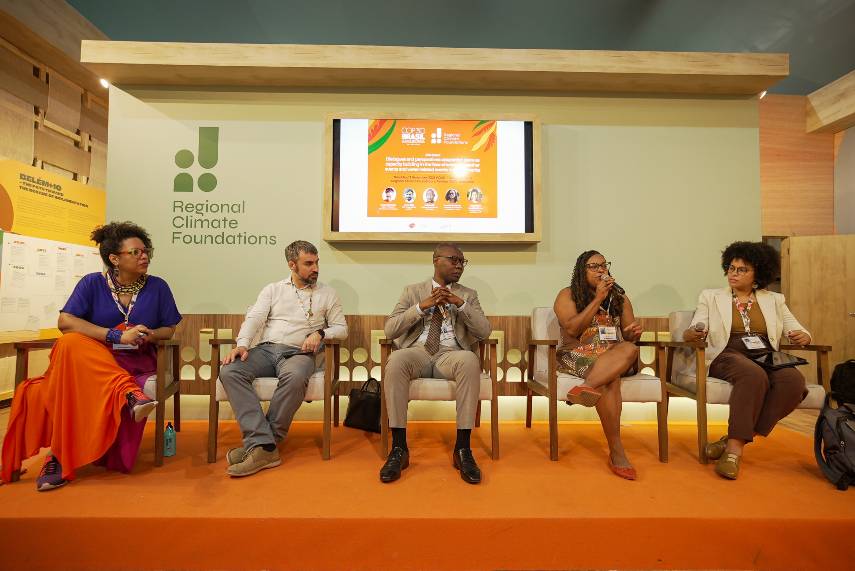
Many panelists of the RCF pavilion call that the voices of young people, women and communities are included in the national adaptation plans — the NAPs, in the wording of the global climate conference. But also highlighted the difficulties that the most affected had to get funds and attention. “Municipalities deal with smaller budgets, but the bigger impacts”, told Thais Ferraz, from Institute of Climate and Society. “It is crucial to work with them”, completed.
An idea that emerged is the necessity of developing local or even small community adaptation plans. “In different territories, we know what is affecting us”, suggested Lorena Terrazas, from Bolivia.
In some cases, not only people that live in the place need to be at the centre, but also those who pass through a specific point. This is the case of the city of Mapastepec, in Chiapas state, Mexico, that is in the middle of many different migration routes between Mexico and the United States. Suffering the impacts of climate change, the community decided to include those migrants into their adaptation plan, creating reception and support centres.
But the migration also impacts the own community, as the territory became militarized. “Due to the militarization, if I want to move in my own territory, I need to cross 11 check-points. And in some cases, I’m obliged to sing the national anthem, to prove that I’m from there”, exposed Pepe Villalobos, from Laycs.
Public resources, but also private funds and philanthropies were remembered as important partners on the adaptation — and the necessity of tripling the finance for this specific topic of climate crisis response, as highlighted by the Secretary-General of the United Nations, António Guterres.
Without any certainty of results, participants of the climate conference that are focused on adaptation returned to home with new inspiration. “COP30 is coming to an end, but we have many new alliances and a lot of work ahead of us. Despite the crisis, we are excited and happy”, concludes Lorena Terrazas.