

On its official opening day, Tuesday, 11, the Regional Climate Foundations pavilion showcased strategies from six different Brazilian states — and also an Argentinian one — on how to implement climate initiatives at the most local level. The talks revealed that collaboration is the main way to overcome barriers such as the finance gap or the lack of technical capacity for projects in the small, more vulnerable communities.
“The climate solution for Brazil and for the world must also be a solution for development and inclusion for the population. Energy transition and social justice are two sides of the same coin”, introduced the state governor of Pernambuco, Raquel Lyra, a Brazilian leader who is joining efforts with politics from different affiliations to attract green industries to the Northeast region of the country.
Lyra and the Piauí governor, Rafael Fonteles, debated on the panel “How to Accelerate Sustainable Investments and Low-Carbon Industrial Chains”. “Our states produce 7 GW of renewable energy and consume only 1 GW. Our energy is 99.73% clean. That is why we are natural candidates to receive green industry”, explained Fonteles.
The Brazilian Northeast states created a consortium and a forum to push for a movement that is called “powershoring” — a concept created by professor Jorge Arbache that consists of moving energy and resource-intensive industries to areas where clean energy is both abundant and affordable. “Northeast is 30 year ahead of others with this initiative”, said Arbache, who participated in the debate.
Brazil’s competitive advantage is evident, as the country’s energy mix is anchored in hydroelectric plants, and the use of fossil fuels is residual. “Brazil has a condition like almost no other country has. We need to add value to this scenario by producing with this green energy. And driving regional development with this perspective”, suggested the executive director of the Climate and Society Institute (iCS), Maria Netto. iCS is supporting the initiative.
By setting up operations near sources of low-carbon energy and key raw materials, companies can reduce their environmental impact and improve resilience to political or climate disruptions. But also, it can become more competitive.
Climate plans promote guidelines for investments
In the last panel of the day, “Turning Collaboration into Local Action for Just Resilience and Nature”, state leaders — including the governor of Espírito Santo, Renato Casagrande — discussed how to provide funding and training to enable municipalities to deal with climate change.
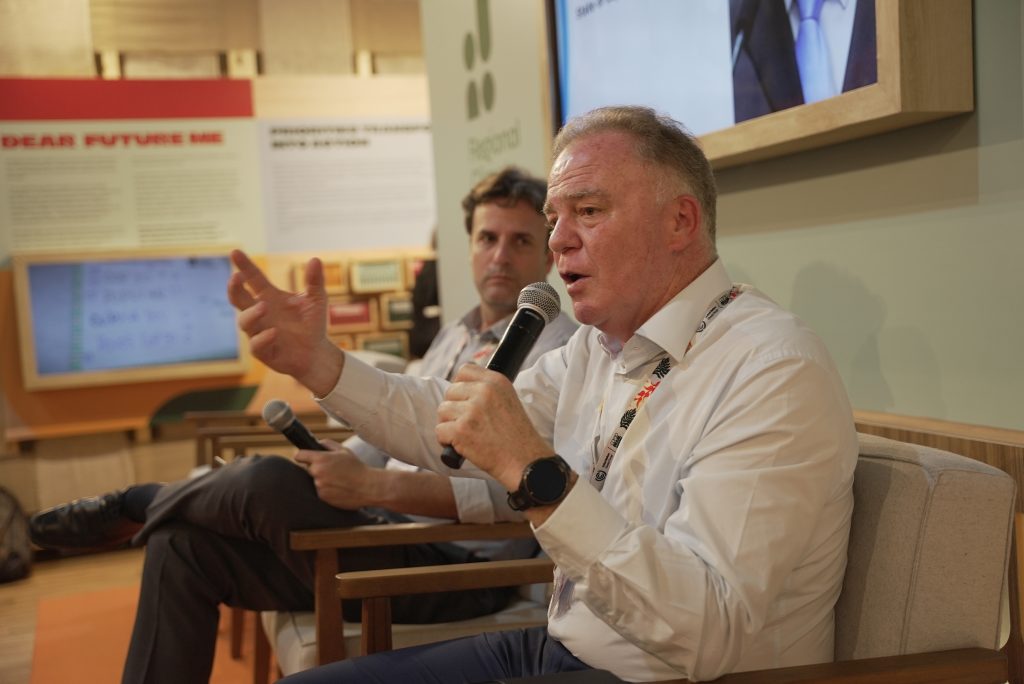
Again, the keyword is collaboration. In this case, the states can either offer reliable data to the very local actors to develop their plans or offer technical support on how to get the funds to implement them. Or both. “Adaptation and mitigation plans cannot come from one government alone; they must come from the state and society. All stakeholders must be involved for them to be feasible”, argued Casagrande. Espírito Santo created a decarbonization fund to push for industry transition, among other initiatives.
The same feeling of public interest being above political affiliations was mentioned by the Secretary of Environment and Sustainable Development of Minas Gerais, Marília Carvalho de Melo. When developing its state’s Climate Change Policy, the main concern was to create indicators that would allow transparency for the society: “We needed to ensure the implementation and monitoring tools because the climate issue cannot be resolved in a single administration, a single term or mandate”.
In São Paulo, the public company Cetesb, dedicated to environmental management, developed a database with a greenhouse gas inventory for each one of all the 645 state municipalities. “So that they would be able to plan the better way to reduce emissions”, said the state sustainability department manager, Maria Fernanda Pelizzon Garcia.
In Paraíba, the challenge has been to include the local population in projects to restore the caatinga, the unique biome of Brazil’s northeast region. “Without the participation of communities, programmes will lack the necessary assertiveness”, expressed the state secretary for the Environment and Sustainability, Rafaela Camaraense.
Coming from Argentina, Victoria Flores, the minister of Environment and Circular Economy of Cordoba department, observed that due to the recent national Argentine government’s position, of skepticism about the Paris Agreement, states departments and municipalities are joining efforts to act: “As our national context is complicated, the provinces are making their own plans, but we are talking so that we can all speak the same language. After all, the difficulties are common to all”.

Participating in the debate, one of the architects of the Paris Agreement, Laurence Tubiana, head of the European Climate Foundation noted that subnational governments need to be more considered in the negotiation aspects. “Since the Paris Agreement we have seen governors with different political affiliations making strong climate action. We need to recognize and celebrate that”, said. “At the same time, subnational governments are the actors that anchor citizens and give them a sense of direction that sometimes lack at national level. So, you need to be at the table”, concluded.