
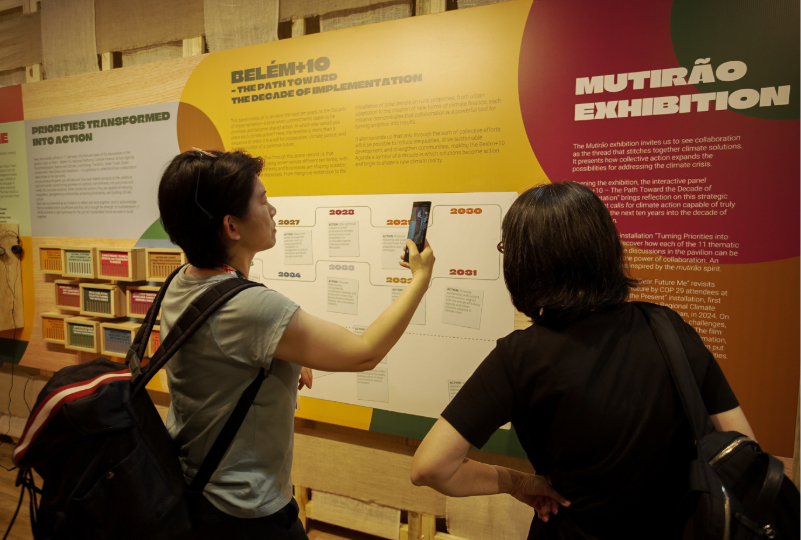
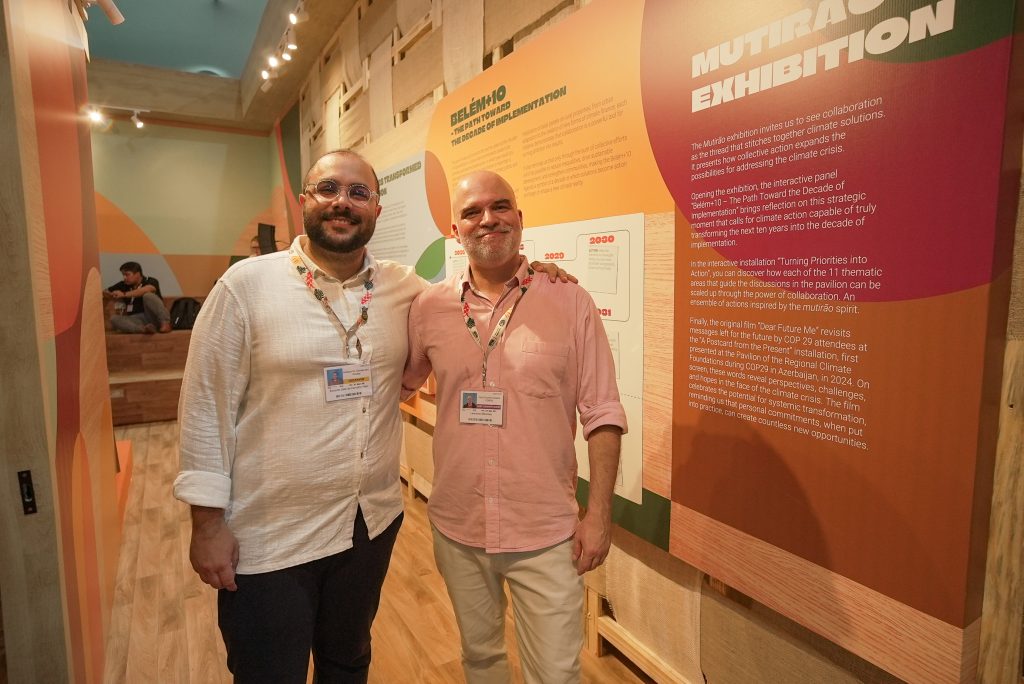
At the heart of the Blue Zone at COP30, in Belém, Brazil, a cultural exhibition at the Regional Climate Foundations Pavilion invites visitors to think about how to act on climate change. Curated by Eduardo Carvalho and Leonardo Menezes, from Outra Onda Conteúdo, the “Mutirão Exhibition” translates complex climate concepts to a broader audience while it explores how creativity and collaboration can help to find solutions for the current crisis.
“Even here at COP, many people are not familiar with the technical terms used in negotiations,” said Carvalho. “We use creative tools and content to make these concepts easier to understand”, adds.
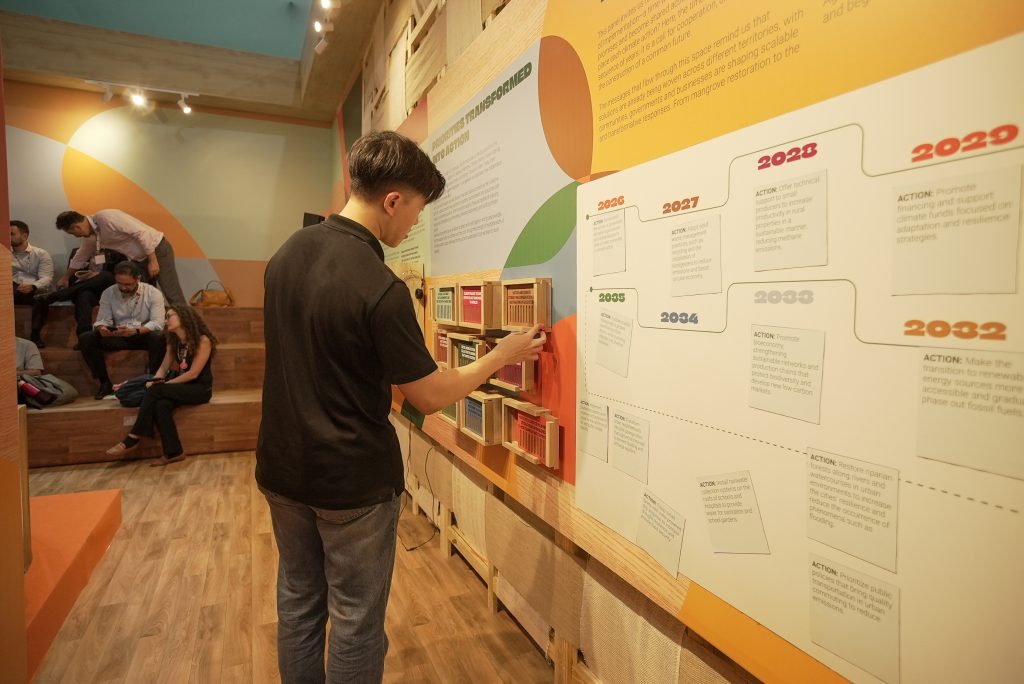
With two of the creations being interactive, the pavilion’s expositions encourage visitors to engage directly, transforming learning into an experience. For example, in the installation “Belém+10: The Path Toward the Decade of Implementation”, asks visitors to envision the years between 2026 and 2035 as a period of concrete transformation, when promises become implementation. With 15 magnetic action proposals, people navigate through the years and choose their priorities, changing the timeline according to their choices.
“It invites the public to leave the zone of abstraction and transform thought into action. They need to touch it, change things from one side to another. This makes them reflect on the path we are moving on, and stimulates their creativity on finding solutions”, explains Leonardo Menezes.
The “Priorities transformed into action” installation has 11 pathways,
where each theme invites reflection and participation, reinforcing that no isolated action is enough. To browse the panel, the visitor has to slide the lids off the wooden boxes, which showcases how collective action can address inequalities, strengthen communities, and build climate justice.
Poetry for climate action
The installation “Dear Future Me” videoart closes the exhibition by revisiting the “A Postcard from the Present” installation first created at COP29 in Baku. There, 187 participants from different countries wrote messages to their future selves in 2050, reflecting on what they hoped to have achieved in combating climate change.
This year, those handwritten messages were transformed into a video artwork and research project in partnership with the University of Exeter. Artificial intelligence helped analyze the content of the postcards, revealing patterns of hope, urgency, and commitment. The study, led by Marcos Oliveira and Eduardo Carvalho, demonstrates how personal reflections can become collective learning tools.
For Carvalho, creativity is essential in climate negotiations because it opens new ways to connect people to complex issues. “Culture is a way to mobilize minds and hearts,” he said. “When people feel part of the solution, they act faster. That’s what this exhibition is about — inspiring reaction as much as action.”
As a final point, Carvalho stated that their message is that the exhibition should be a creative collective effort to inspire people to react as soon as possible. “More than acting, reacting”, he concluded.
Finally, another screen positioned at the pavilion’s entrance, works by touch to showcase the eleven thematic areas prioritized b the Regional Climate Foundations this year, including just energy transition, climate finance, nature and climate, and social mobilization. In addition, the screen presents the eight RCF around the world.
Mutirão concept inspired the pavillion design
The “Mutirão” concept — a Brazilian method of social mobilization, originated from indigenous traditions — is central to the exhibition, aligned with the COP30 Presidency.
Menezes explained that the wall decoration, made of interwoven jute fabrics — a vegetable fibre mainly cultivated in the Amazon influenced by the Japanese community — symbolizes collaboration as the “thread that stitches together climate solutions”, in the sense that “to collaborate, we need to bring together common agendas that can intersect,” he marked. The exhibition reflects the idea in both its design and content: geometric forms that overlap to create new colors, representing how diverse contributions can merge to generate new possibilities.
According to Menezes, it brings the idea of addition, of intertwined efforts. “We need to cross possibilities and paths, which is not a straight line. This intertwining is something that will create a new situation”, the curator explained.