
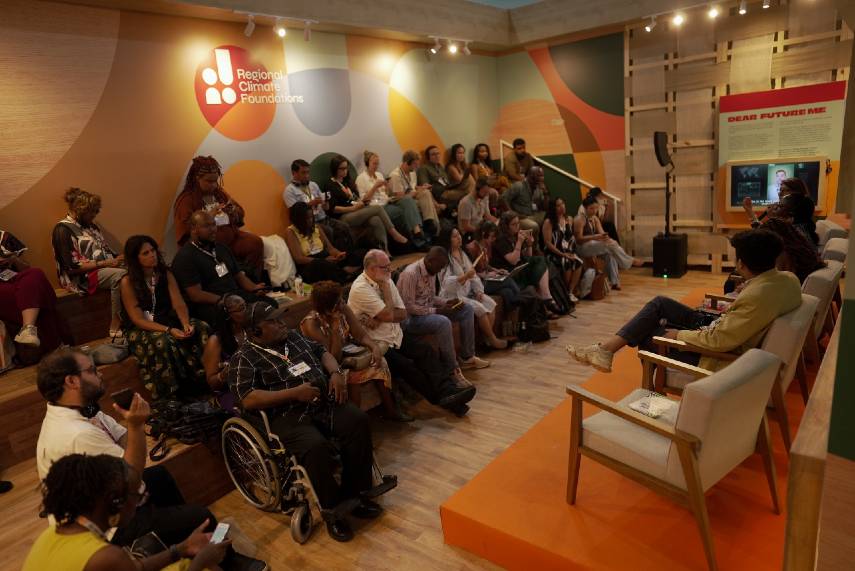
The saying that ‘faith moves mountains’ proved true in a small village in Honduras where, after 40 years of fighting for residues of selective recollection, the outcome was achieved when a local pastor led a campaign and called authorities to be accountable. In Kenya, the disproportional battle between David and Goliath was reproduced by local grassroots movements that felt empowered by their faith and started to elevate their voices to call for phasing out fossil fuel exploration on their territories.
Those were some of the stories told at a meeting held this Tuesday, 18, on the Regional Climate Foundations pavilion at COP30 in Belem, Brazil. “People that are religious believe and are mobilized, so faith is a powerful tool to collectively overcome difficulties through a movement that puts people and hope at the center”, stated the Global Organiser Director at GreenFaith, Meryne Warah.
It is not new that religious leaders and structures are quite active on climate issues when it comes to bringing assistance to communities affected by an emergency — a flood, for example. But facing the extreme weather events led these leaders to think better about their reasons — and solutions for the communities they serve to. “It is very difficult to deliver a sermon to a congregation displaced or that was hit by hunger caused by climate change”, highlighted Warah.
So, in many places, pastors, priests, indigenous spiritual references are taking action to avoid the worst impacts. “Religious leaders are both influential on the territories and on local governments”, added José Vitor, from Black Christian Movement Brazil. “By their influence, they are able to bring adaptation and climate measurements to the territories”, completed.
Increasing role
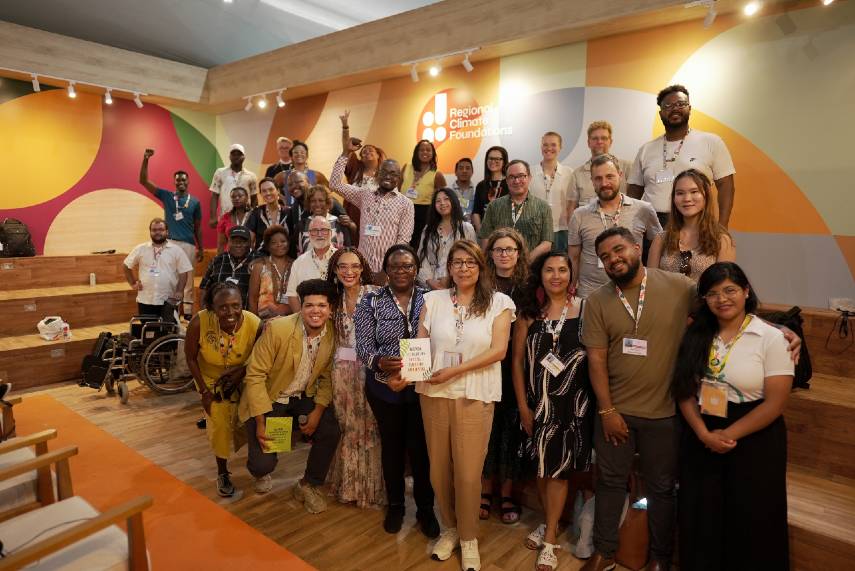
The role of faith and religion on climate change is increasing with more organised movements, such as GreenFaith or the Brazilian Acacia Project, from Black Christian Movement Brazil — that select and train spiritual leaderships from communities on climate action.
But it is not new. “The concept of environmental racism was forged by a pastor from the Baptist Church in the United States of America”, reminded Vitor. “Unfortunately, we have seen churches and religious leaders getting far from the violence that their communities suffered”, added.
“Defending the planet means protecting God’s creation. But not only that: it means protecting my relationship with my neighbour, with myself, with my environment”, stated Miriam Moreno, from Tearfund. “Religion offers a perspective that goes beyond individual responsibility and shows that what is needed is a systemic energy change”, concluded.
Audience echoed the panelists
The debate with the audience, following the panelists’ presentations, was rich. A woman who works with marginalized communities in Rio de Janeiro pointed out that these are the regions that suffer most from the impacts of climate change: “Due to a lack of urban planning, segregation and social exclusion, many of these areas do not have schools, health services or security. The state is absent”, she said. “If you ask people, many will not be part of a union or an NGO. But 100% of them have some connection to a faith community”, added.
Also in the audience, Lorena Froz gave a testimony about what happens in her spiritual space of black African ancestry: the Ossain do Ile Ase Méjì Omi Odara. “I’m from Candomblé, and we are no longer using certain vestments and objects to leave out in nature”, revealed. “We need to think globally about how to bring climate thinking to the care of our territories”, concluded.