

COP30 ended with a mix of frustration and forward motion, but the Brazilian presidency’s push to shift the climate conference from an annual event to a continuous process is energizing leaders at the Regional Climate Foundations. “It represents an opportunity for our philanthropic organisations, perhaps more than ever before,” says the executive director of the Institute for Climate and Society (iCS), Maria Netto.
At the end of the Belém climate conference, without consensus on fossil fuel phaseout proposals, the Brazilian presidency took on the task of developing a roadmap for transition away from those that are the main greenhouse gas sources in the upcoming months. This will require year-round coordination with governments, regulators and financial institutions.
“Brazil’s proposal opens up opportunities for participation and advocacy for RCFs, as we can react quickly by mobilising technical capacities and financial support”, adds the executive director of Climate Initiative of Mexico (ICM), Adrián Fernández. Mexico was one of the 80 countries that signed a declaration for the fossil fuel phaseout.
Another roadmap promised is the one for halting and reversing deforestation. The expansion of the Tropical Forests Forever Facility — a mechanism to deliver long-term, results-based payments to tropical forest countries for conservation — is another point that will receive attention in the following months, as well as advancing the financing priorities of the Circle of Finance Ministers. This includes the operationalization of the new Country Platforms Hub.
“The logic of a ‘continuous COP’ allows RCFs to operate throughout the inter-COP cycle, offering support for new structural projects, and coordination with the Baku–Belém Roadmap”, analyses Netto .
Fernández agrees, as the philanthropic network can work along with climate decision-makers to move forward quickly and flexibly with policy and action formulation. Especially when it comes to finance, RCFs can play a decisive role: “Our foundations can mobilize short-term resources while advancing international management processes for larger-scale grants and loans”.
Overall, COP30 “delivers much-needed political momentum”, states Shakti Energy Foundation. “For developing countries, the priority is to accelerate clean energy transitions, embed climate considerations into economic planning, and expand implementation capacity in the lead-up to COP-31 and COP-32”, completes the RCF from India.
Sub-national governments gain importance
The absence of some countries from the conference, as the United States, or delegations facing government contradictions, as Argentina, states and cities emerged from COP30 as key players on climate issues.
The visibility of “sub-nationals” actors opens space for the Regional Climate Foundations to act, supporting urban adaptation plans, developing methodologies for measuring risk and resilience, and building networks of resilient municipalities, in Maria Netto’s perspective. She also highlights the opportunity to connect subnational entities from different countries for technical cooperation and fundable projects.
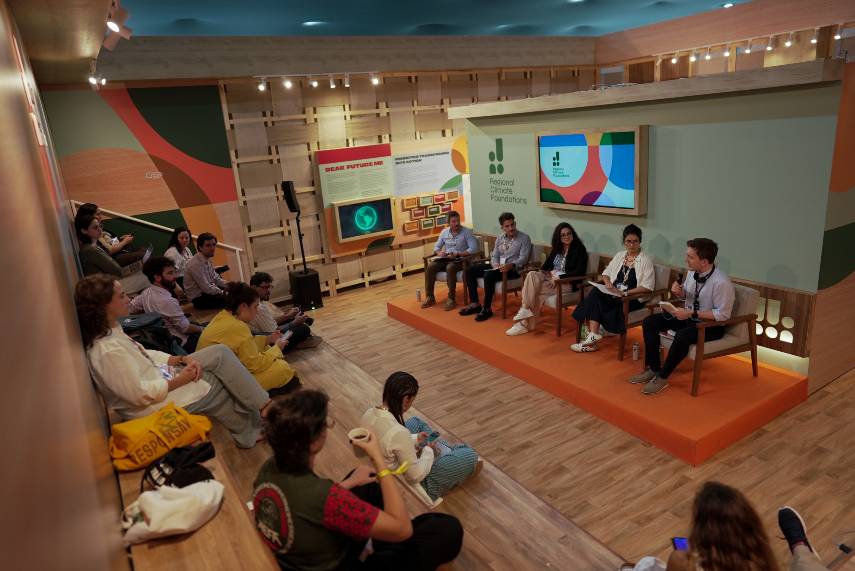
“COP30 amplified the role of sub-national climate action, which directly aligns with the coalition’s mandate”, states Shakti, remembering some debates conducted inside the RCF pavilion that showcased best practices from India and other regions on adaptation and mitigation. “We demonstrated how state-level policies on renewable energy, green industries, electric mobility, and nature-based resilience are already delivering measurable impacts”, the organisation says.
The Indonesian RCF sister, ViriyaENB highlights one specific achievement of COP30, that is better measurable on a local perspective: the formal recognition of health co-benefits in climate decisions. The climate conference set 59 voluntary, non-prescriptive indicators to track progress under the Global Goal on Adaptation. Health was among these indicators. “Hopefully, the health co-benefits are going to get more traction in the future, as we progress our efforts in climate change mitigation and improving air quality”, expects the organisation.
RCF pavilion connected COP30 to the real world

After three years appearing as a coalition during climate conferences, the Regional Climate Foundations ended COP30 with a coherent and strong identity. “We have turned the term RCF into a brand”, explains Adrián Fernández. “We are a family of organizations that share an interest in making strategic grants to enable many other organizations to have greater impact on climate policy in their countries”, completes.
Shakti agrees: “COP30 significantly strengthened the Regional Climate Foundations coalition, both in substance and in visibility”, states the organisation, highlighting some pavilion sessions that exposed solutions from Global South to the world.
“The RCF Pavilion is a unique space where the most relevant topics of COP30 were discussed while experiences from the countries and regions where the different RCFs work were exchanged”, adds Fernández.
From Brazil, Maria Netto, executive director of the Climate and Society Institute (iCS), emphasized the central role of connecting negotiation rooms with implementation-focused spaces like the RCF Pavilion. Negotiators, she explained, work with global targets — finance, adaptation, trade, indicators, just transitions — while the pavilion brings forward “the institutions and coalitions that make these goals feasible in real territories.”
She pointed to the example of Country Platforms: while finance ministers outlined priorities in the plenary, the RCF Pavilion showed how regional philanthropy can provide project preparation, governance, transparency and social participation, “essential elements that do not appear in negotiations but are indispensable for these platforms to work.”
For Netto, COP30 represented “a qualitative leap” for the coalition, consolidating the RCFs as “the philanthropic infrastructure of the Global South for implementation of the Paris Agreement,” and creating stronger alignment around themes such as adaptation and climate justice.